Treating versus monitoring after a termite find
Live termites in a Newcastle purchase are a decision, not a weekend DIY job — chemical barriers and baiting in general terms, structural repairs, vendor obligations, and the case for walking away.
By Tom Reilly, Timber pest correspondent · 27 June 2024 · Updated 18 September 2025 · 11 min read
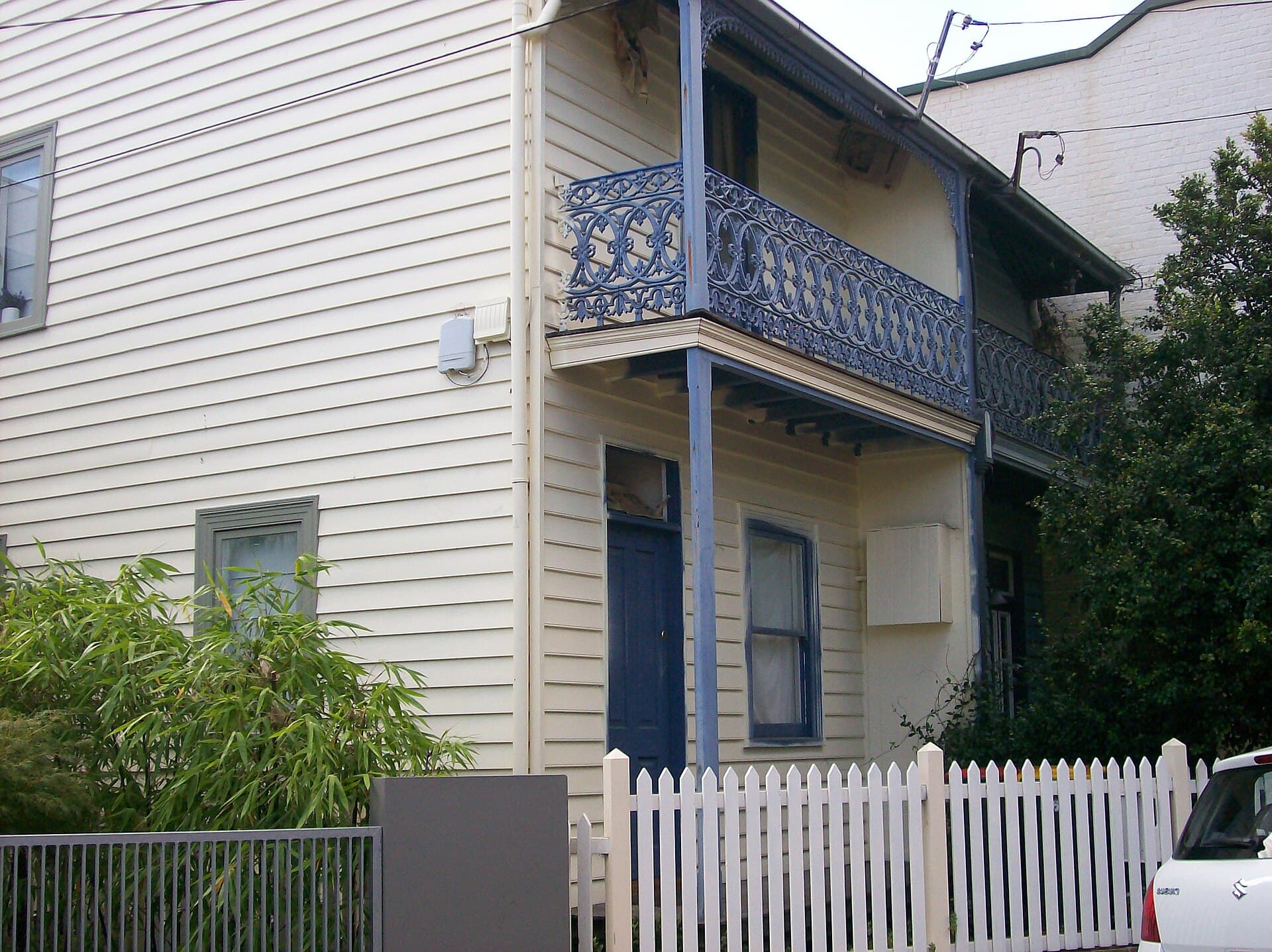
Photo: Michael Gardner. Weatherboard terraces. Public domain. Source on Wikimedia Commons. Licence. Full credits on the image credits page.

The sentence you did not want is usually short. Live termites in a bearer. Fresh mudding on a pier. A gallery in a window reveal of a weatherboard terrace you had already named in conversation as “the one”. The inspection was supposed to make the purchase feel adult. Instead it has handed you a fork: treat, monitor, or leave.
This essay is about that fork after a find in a purchase. It is not a product comparison and it is not a treatment manual. For how the insects live in this region, read termite risk in the Hunter. For how they were found, read what a timber pest inspection looks at. What you do next sits in the after the inspection hub as much as in pest and termite.
First, believe the report
A pre-purchase timber pest inspection is an opinion on accessible areas at a point in time. If it records live termites, do not start by hoping the inspector mistook ants for Coptotermes. Ask for photographs, the location, and whether the insects were identified. Call the inspector if a sentence is ambiguous. Then slow down.
The building report, if you commissioned one — see what a pre-purchase building inspection covers — may already be talking about bounced floors, wet bathrooms, or a roof that is finished. Those facts now have a pest context. A combined PDF can bury the live finding under a “fair condition” summary. Unpack it. The combined versus separate essay exists because this confusion is common.
Read the limitations before you decide the house is either doomed or fine. Cavities were not opened. The neighbour’s tree was not climbed. Limitations and the fine print are not a way to talk yourself out of a live finding. They are a way to estimate how much more timber you have not seen.
The purchase decision is still a purchase decision
You are not obliged to buy a house with termites in it. You are not obliged to be brave. Walking away is a legitimate response to:
- live activity in structural timber you cannot see the end of
- a vendor who will not allow invasive inspection or a proper treatment discussion
- a price that only worked if the house was “a bit of paint”
- a construction type — slab, party wall, finished interiors — that makes treatment and repair expensive in ways the report can only hint at
- your own temperament, if you are not going to maintain the place
Walking away is easier before exchange than after. Auction is less forgiving than a private treaty with cooling-off. None of that is a reason to treat the finding as a bargaining chip and then forget to follow through. If you stay, you stay as someone who owns a termite problem, not as someone who won a discount.
Chemical barriers and baiting, without the brands
Two families of professional work
Licensed pest management technicians in this state have, broadly, two families of response to subterranean termites. Both are professional work. Neither is a personality test about whether you prefer “chemicals” or “baits”. Both fail when they are done as a gesture.
Soil and timber treatments — often discussed as chemical barriers or termite management systems — aim to put a treated zone between the colony’s foraging paths and the building, or to treat infested timber directly where that is appropriate. Around a house this can mean trenching or injecting at the perimeter, treating along a slab edge, sometimes drilling a path through concrete, sometimes treating inside a wall with the holes patched afterwards. The point is a treated zone the insects cannot casually cross, and the disruption of the gallery that was in the building.
Baiting aims at the colony. Stations go in the ground around the site. The insects feed, share, and — if the program works — the colony collapses. Baiting is slower to show you an empty piece of timber. It is also not a set-and-forget row of plastic lids. It is inspections, replenishment, and a technician who will tell you when the stations are inactive because the colony has declined, and when they are inactive because nobody is home.
Hybrids exist. Direct treatment of an active gallery plus a baiting program around the site is a common adult sentence. What does not exist is a weekend product that does the same job from a supermarket shelf.
I will not name brands. I will not pretend one method is always kinder, greener, or more complete. The right choice depends on the species, the nest location if known, the construction (timber floor versus slab), the access, whether you own the house yet, and whether you are trying to make a purchase settle or trying to live there for twenty years. Ask the technician to explain the method in language that would survive a second opinion. Ask what “success” will look like on a follow-up inspection. Ask what they will not promise.
A treatment is not a certificate that the species has left the suburb. Coptotermes acinaciformis will still be in the Hunter on Monday. The job is to make this building a worse prospect, and to know when to look again.
Structural repairs are a separate invoice
Killing or excluding the insects does not put the cellulose back.
A worked bearer, a chewed bottom plate, a window reveal that is a skin of paint over dust — these are building problems. They need a builder, sometimes an engineer, sometimes a carpenter who is willing to open a wall in a weatherboard cottage and tell you the truth. Treatment without repair is how people end up with a “treated” house that still bounces.
Get the pest findings and the building defects into the same conversation. A pre-purchase report that already flagged movement or moisture is now a repair map. Coastal fabric from Stockton to Redhead may also be dealing with rusted fixings; that is coastal corrosion, not a reason to ignore the termites. Inner-suburb timber and lake fibro each fail in their own way — the Hunter housing hub is the catalogue. The repair quote should follow the damage, not the suburb’s reputation.
If nobody can see the end of the damage without opening up, you do not yet have a repair quote. You have an estimate of how optimistic you are. Invasive inspection, with permission, is sometimes the only way to know whether you are buying a house or a project.
Vendor obligations, which are narrower than buyers hope
New South Wales still expects buyers to look. A typical sale does not include a statutory duty on the vendor to treat termites before settlement, or even to tell you, unprompted, the full history of every winged insect on the block. That is why you commissioned the inspection.
What the vendor should not do is mislead. A statement that the house has “never had termites”, a treatment certificate waved as if it were current when it is a decade old, a hatch blocked “by accident” on inspection day — these are not charming. Australian Consumer Law cares about misleading conduct. So do the ethics of a decent agent. They are not the same thing as a clause that forces a treatment.
What you can do, in a private treaty, is negotiate:
- a licensed treatment before completion, with certificates and a defined method
- access for invasive inspection
- a price adjustment that actually funds treatment and repairs, not just the chemical
- a special condition that lets you walk if live activity is confirmed in structural members
- copies of any previous pest reports and treatment records, which you will read as history, not as a warranty
A vendor-commissioned report is a report written for the vendor. Commission your own. If they already have a fresh treatment, verify it with someone who is not selling you the next one.
Auction is a harder room. If you have the finding before auction, you either price it in, set a limit that assumes a project, or stay away. After the hammer, your options shrink. That is not cruelty unique to termites. It is how auctions work.
Do not DIY the insects
This is the paragraph that should not have to exist.
Do not inject random liquids into a wall cavity because a forum was confident. Do not disturb an active gallery with a screwdriver and a bad mood — you can drive the insects further into the building and destroy the evidence a technician would use. Do not assume that painting a mud tube is a treatment. Do not skip the licence question because a relative “does pest stuff”.
Termite work in New South Wales is licensed pest management, with products you are not entitled to splash about. Incomplete treatment can split a colony, leave untreated foraging paths, and give you a story to tell the next inspector that makes their job harder. The money you save is not saved. It is deferred, with interest, into a wall you will later open.
If you are not yet the owner, DIY is also a way to damage someone else’s house. Do not do that.
Monitoring as a program, not a shrug
Monitoring is legitimate when it is a plan.
A plan looks like this: a licensed technician has treated, or has given a reasoned view that activity is not current; moisture sources are being fixed; vents and soil grades are being corrected — see subfloor ventilation and moisture; a follow-up timber pest inspection is booked; bait or in-ground stations, if installed, are actually inspected; you keep the certificates.
A shrug looks like this: “we’ll keep an eye on it”, no date, no technician, no repair to the shower that caused the problem, a weatherboard wall still buried in garden.
After settlement, living with a fair report is the temperament required. Fair, in this context, can include historic workings and a treatment you intend to honour. It does not include live termites you decided were “probably gone” because the purchase was otherwise lovely.
If the find is live and structural and the vendor will not move, monitoring is not your purchase strategy. Leaving is.
A note on this journal
We do not treat houses. We do not sell bait stations or soil products. We do not take a referral fee from technicians. The point of this page is to keep you out of the hardware aisle, and to make “we’ll monitor it” mean a calendar rather than a hope.
Questions readers ask
- Can I treat termites myself with a hardware-store product?
- You should not. Incomplete treatment can split a colony, drive insects deeper into the building, and leave you with chemicals you are not licensed to use. Hire a licensed pest management technician and keep the paperwork.
- Does the vendor have to treat before settlement?
- Not automatically, in a typical NSW sale. You can negotiate a treatment, a price adjustment, or an exit. Concealment and misleading statements are a different problem from a silent contract.
- If the termites are gone, can I just monitor?
- Sometimes, if a licensed technician has given you a reason to believe activity has been eliminated and you are prepared to inspect, fix moisture, and budget for surprise. Monitoring is a program, not a mood.
Keep reading
Subfloor ventilation and moisture in coastal Newcastle
From Stockton to Redhead the crawl space stays wet — blocked vents, plastic on soil, bathrooms leaking into the dark, and why lake suburbs and rising-damp language keep getting in the way of a clear diagnosis.
Tom Reilly · 5 September 2024 · 10 min read · Photo: DaHuzyBru, CC BY-SA 4.0
What a timber pest inspection looks at
A practical account of AS 4349.3 in Newcastle and the Hunter — soundings, mudding, frass, roof voids, subfloors and the landscaping that feeds a house, plus the cavities no honest inspector will pretend to have seen.
Tom Reilly · 2 May 2024 · 11 min read · Photo: Sam Wilson, CC BY-SA 2.0
Combined building and pest versus separate reports
AS 4349.1 and AS 4349.3 are different jobs. In Newcastle they are often sold as one afternoon — what you gain in convenience, what you lose in attention, and when a specialist timber pest inspection is worth commissioning on its own.
Tom Reilly · 28 March 2024 · 10 min read · Photo: One Salient Oversight, Public domain